Frankly, …热身 · 约 5 分钟 · 引入主线
Guiding questions
- Think of something true that you'd find difficult to say to someone in your family. (Keep it in your head.)
- Compare: "Your cooking is terrible." / "Frankly, your cooking is terrible." / "Admittedly, your cooking isn't the best." Which one starts a war?
- So what does one word at the start of a sentence actually do?
"Frankly, it's terrible."direct · may hurt
"Admittedly, it's not the best."softer · I admit
这节课两件事:① 句首一个副词决定你的态度(坦白 / 承认 / 希望 / 显然);② 一组"吵架"固定搭配,说错一个词就不地道。
"Frankly" makes it more direct and possibly more hurtful; "Admittedly" softens it by presenting it as something you have to admit. The adverb tells the listener how the speaker feels about what they're saying.
句首这一个词,就决定了对方听到的是"我早就想说了"(frankly)还是"不得不承认"(admittedly)。
课堂对话
Quick thought experiment. Think of something true that you'd find really difficult to say to someone in your family. Don't say it out loud. Just think of it.
给 15 秒思考。
Got one? Now three versions of the same message. One: "Your cooking is terrible." Two: "Frankly, your cooking is terrible." Three: "Admittedly, your cooking isn't the best." Which one starts a war?
The second one. "Frankly" makes it sound like you've been waiting to say it.
Ha! And the first?
It's rude, but "frankly" makes it even more direct.
And the third?
It's softer. "Admittedly" sounds like you don't really want to say it, but you have to admit it.
So one word at the start of the sentence changes the whole relationship. What does it do?
It shows the speaker's attitude about the thing.
Exactly right. Small preposition fix: attitude TO or TOWARDS something. And here, even better: it shows how the speaker feels about what they're saying.
It shows how the speaker feels about what they're saying.
That's the definition from the rule box, word for word. Today's question: how do you say something difficult to a family member without starting a war? You'll need two things: attitude adverbs, and the vocabulary of conflict, which you found on the web page last lesson.
Get your circles from last lesson ready. Let's see what you found.
Four adverbs from the web page填副词 · 约 6 分钟 · Exercise 6
Guiding questions
- Try from memory first: which adverb goes in each sentence?
- Check in the web page. Who said each one, and what were they feeling?
- Which adverb admits a point against your own argument? Which one wishes? Which one says "everyone can see this"? Which one says "there's no doubt"?
| Adverb | Speaker means… | Chinese |
|---|---|---|
| hopefully | I hope that… | 但愿 |
| obviously | it's clear to everyone that… | 显然 |
| undoubtedly | there's no doubt that… | 毫无疑问 |
| admittedly | I have to admit that… (it weakens my point) | 诚然、不得不承认 |
= 让步:先承认对方有理,再转回自己的观点
1 Hopefully(Greg) 2 obviously(Robyn) 3 undoubtedly(Cathy) 4 Admittedly(Matt)
admittedly 是让步:先承认一点对自己不利的(some are spoiled),再用 but 转回自己的观点(plenty aren't)。这样说显得公平,对方更愿意听下去。
课堂对话
Exercise 6. Try from memory first, then check. Four adverbs, four sentences. Number 1: blank, I'll hear from some of you who are onlies.
Hopefully. Greg wants people to reply.
Number 2: It's blank very hard to compare them.
Obviously. That's Robyn: you can't experience both, so it's obviously hard to compare.
Number 3: He's blank my parents' favourite.
Undoubtedly. Cathy, about her brother.
How sure is she?
A hundred percent. No doubt at all.
Number 4: blank, some are spoiled, but there are plenty who aren't.
Admittedly. That's Matt.
Now the interesting one. Why does Matt say "admittedly"? Is he on the "onlies are spoiled" side?
Yes, he admits that onlies are spoiled.
He admits SOME are. But then what's the next word?
"But". So he admits a small point against himself, and then he goes back to his real point: plenty aren't.
That's the job of "admittedly": 先让一步,再反击. It makes you sound fair, so people are more likely to listen to the rest. Try one. Admit something about your own family, then say "but".
Admittedly, my brother can be really annoying, but he's always there when I need him.
Lovely. You conceded, then defended. Check all four in the web page now, and underline who said what.
学生回到 p.16 核对,标出说话人。
Find four more + the rule找规律 · 约 8 分钟 · Exercise 7 + RULE
Guiding questions
- Find four more attitude adverbs in the web page. Who uses each one?
- Complete the rule. Where do these adverbs usually go?
- "Frankly" and "honestly": are they the same? Which one is more likely to hurt?
- "Inevitably" and "understandably": what extra meaning does each one add?
| Adverb | From the web page | Adds… |
|---|---|---|
| honestly | I honestly don't understand why… (Greg) | sincerity: I really mean this |
| frankly | frankly I wish I didn't! (Cathy) | bluntness: I'll say it directly |
| understandably | Understandably, you're upset (Matt) | sympathy: your reaction makes sense |
| inevitably | inevitably we're going to see more… (Greg) | no way to avoid it |
or after the initial verb → He's undoubtedly my parents' favourite.
RULE(any order): honestly, understandably, inevitably, frankly
位置:分句开头(Frankly, I wish I didn't.),或紧跟第一个动词 / be / 助动词之后(He's undoubtedly…)。honestly = 真心话;frankly = 直说,可能伤人;understandably = 你的反应可以理解;inevitably = 躲不掉。说 Frankly 就够了,Frankly speaking 听起来很老派。
课堂对话
Exercise 7. Four more attitude adverbs are hiding in the web page. You circled them last lesson. Who's got all four?
Honestly, frankly, understandably, and inevitably.
Who uses each one?
Greg says "I honestly don't understand why people think this way". Cathy says "frankly I wish I didn't". Matt says "Understandably, you're upset". And Greg says "inevitably we're going to see more and more onlies".
Complete the rule with those four. Done. Now the position. Look where they sit. "Frankly, I wish I didn't."
At the start of the sentence.
"He's undoubtedly my parents' favourite."
After the verb "is".
That's the rule: start of the clause, or immediately after the initial verb. Now, frankly and honestly. Same?
Not exactly. "Honestly" means I'm being sincere. "Frankly" means I'm being direct, maybe a bit rude.
Which one would you use with your grandma?
Honestly. "Frankly" to your grandma sounds like you're about to criticise her.
Frankly speaking, I don't like my uncle's jokes.
Ha, a very common one. Chinese students love "frankly speaking". It's not wrong, but it sounds old-fashioned and a bit textbook. One word does the job.
Frankly, I don't like my uncle's jokes. Although that's probably not something I'd say to his face.
Wise. Now "understandably". Matt says "Understandably, you're upset." What's he doing to Cathy?
He's showing sympathy. He means: of course you're upset, it makes sense.
And that's a key tool for today's question. If you start with "understandably", the other person feels heard. And "inevitably"?
It means it can't be avoided. It will definitely happen.
Inevitable, more people will have only one child.
You've got the meaning. But you used the adjective. At the start of a sentence, as an attitude word, we need the adverb, with -ly.
Inevitably, more and more people will have only one child.
Turn it into an adverb句子改写 · 约 9 分钟 · Exercise 8
Guiding questions
- Check: frank and inevitable. What do they mean?
- Change the underlined word into an adverb and make one sentence. Where can the adverb go?
- Number 4: "This is something I have to admit." Why can't the adverb go at the very start of the whole sentence?
- Which of your sentences sounds the kindest, and which the harshest?
| Word | Adverb | Spelling trap |
|---|---|---|
| frank · hope · inevitable | frankly · hopefully · inevitably | -ble → -bly |
| admit · understand | admittedly · understandably | tt · -able → -ably |
| honest · obvious · no doubt | honestly · obviously · undoubtedly |
每题不止一种位置。句首 + 逗号最保险;在 be / 助动词后面也可以;frankly / obviously 还能放句末加逗号表强调。
1 Frankly, your haircut looks terrible. / Your haircut looks terrible, frankly!
2 Hopefully, my brother will lend me his jacket. / My brother will hopefully lend me his jacket.
3 Inevitably, I won't pass the test because I didn't study enough.
4 I'm good at languages, but, admittedly, my sister is better than me at Maths.
5 Understandably, you're angry with me for being mean to my sister. / You're understandably angry with me…
6 Honestly, I would never hurt my sister. / I would honestly never hurt my sister.
7 Obviously, my brother is jealous of me. / My brother is obviously jealous of me. / My brother is jealous of me, obviously!
8 Undoubtedly, we'll be tired when we arrive. / We'll undoubtedly be tired when we arrive.
每题不止一种位置,句首加逗号最保险。4 最难:你承认的是"妹妹数学更好",所以 admittedly 要放在 but 后面那半句,紧挨着它修饰的内容。拼写:admittedly(双 t)、undoubtedly(不是 undoubtly)、understandably、inevitably。
课堂对话
Exercise 8. Two key words first. "Frank"?
Honest and direct. Saying exactly what you think.
"Inevitable"?
Certain to happen. You can't stop it.
Now, eight pairs of sentences. Turn the underlined word into an adverb and make one sentence. Number 1 together: "Your new haircut looks terrible. I'm being frank about this."
Frankly, your new haircut looks terrible.
Any other position?
At the end: "Your haircut looks terrible, frankly!" That sounds even ruder.
Ha, yes, it's like a slap at the end. Do 2 to 8 alone, and for each one try two positions if you can. Four minutes.
巡视。时间不够可以留作业。重点检查拼写 admittedly / undoubtedly / inevitably。
Number 2, the jacket.
Hopefully, my brother will lend me his jacket. Or: my brother will hopefully lend me his jacket.
Number 3.
Inevitably, I won't pass the test because I didn't study enough.
Number 4 is the tricky one. Why can't we start with "Admittedly, I'm good at languages"?
Because I'm not admitting I'm good at languages. I'm admitting my sister's better at Maths. So it has to go in the second part.
Exactly. The adverb sits next to the thing it's about. So?
I'm good at languages, but, admittedly, my sister is better than me at Maths.
Number 5.
Understandly, you're angry with me for being mean to my sister.
The position is perfect. The spelling lost a syllable. Understand, ABLE, LY. Understandably.
Understandably, you're angry with me for being mean to my sister.
Number 6.
I would honestly never hurt my sister.
7 and 8.
My brother is obviously jealous of me. And: we'll undoubtedly be tired when we arrive.
I wrote "undoubtly".
Very common. The word is un-DOUBT-ed-ly. Four syllables. Say it.
Undoubtedly. We'll undoubtedly be tired when we arrive.
Now the question that matters: which of your eight sounds the kindest, and which the harshest?
The kindest is number 5, "understandably", because you're accepting the other person's feelings. The harshest is number 1 with "frankly" at the end.
So if you need to say something difficult to your sister, which adverb would you start with?
"Understandably" or "admittedly". Show you see their side first, then say the difficult thing.
Conflict collocations冲突搭配 · 约 8 分钟 · Exercise 9
Guiding questions
- Match the sentence halves from memory first, then check in the web page.
- Explain each phrase in your own words. Which ones describe the problem, and which describe a reaction?
- Which word in each phrase can't be changed? (Can you "make on my nerves"? "put up from"?)
| Phrase | Meaning |
|---|---|
| get on sb's nerves | annoy sb repeatedly 烦人 |
| have a word with sb | have a short, serious talk 谈一谈 |
| make things worse | add to the problem 火上浇油 |
| say something you might regret | say something hurtful in anger 说气话 |
| put up with sth | tolerate 忍受 |
| make sb's life miserable | make sb very unhappy 让人日子难过 |
| let sb be | leave sb alone, don't interfere 随他去 |
| get into fights | start fighting 打起来、吵起来 |
1g 2a 3h 4b 5f 6c 7d 8e
描述问题:get on sb's nerves · make sb's life miserable · get into fights。应对方式:have a word with · let sb be · put up with · make things worse · say something you might regret。这些是固定搭配,一个词都不能换。
课堂对话
Exercise 9. Eight conflict phrases. You circled most of them on the web page. From memory first, then check. Two minutes.
Number 1: "My little sister really gets on…"
g, my nerves when she keeps taking my things.
2: "Dad said he wants to have a…"
a, word with me. What could it be?!
Is "having a word" relaxing?
No! It's usually bad news. Like when the teacher says "can I have a word?"
Ha, 被叫去办公室的感觉. 3?
h. You'll only make things worse for me.
4?
b. I don't want to say something I might regret.
5?
f. I really can't put up with all that noise anymore.
6: "My elder sister made…"
c. My life miserable when we were younger.
7: "Why don't you just let…"
d. Him be and get on with your own life.
8?
e. He's always getting into fights with the other kids.
So: 1g, 2a, 3h, 4b, 5f, 6c, 7d, 8e. Now explain the meaning. "Put up with"?
It means to stand something. Like, I can't stand up with the noise.
You've mixed two phrases, and both are good! "I can't stand the noise", or "I can't put up with the noise". Not "stand up with".
I can't put up with the noise. Or: I can't stand the noise.
"Let him be"?
Leave him alone. Don't try to change him.
Which ones describe the problem, and which a reaction?
Problem: gets on my nerves, make my life miserable, get into fights. Reaction: have a word, let him be, put up with, say something you might regret, make things worse.
Good analysis. And now look: which reactions answer our big question well, and which start the war?
"Have a word" and "let him be" are peaceful. "Say something you might regret" and "make things worse" start the war.
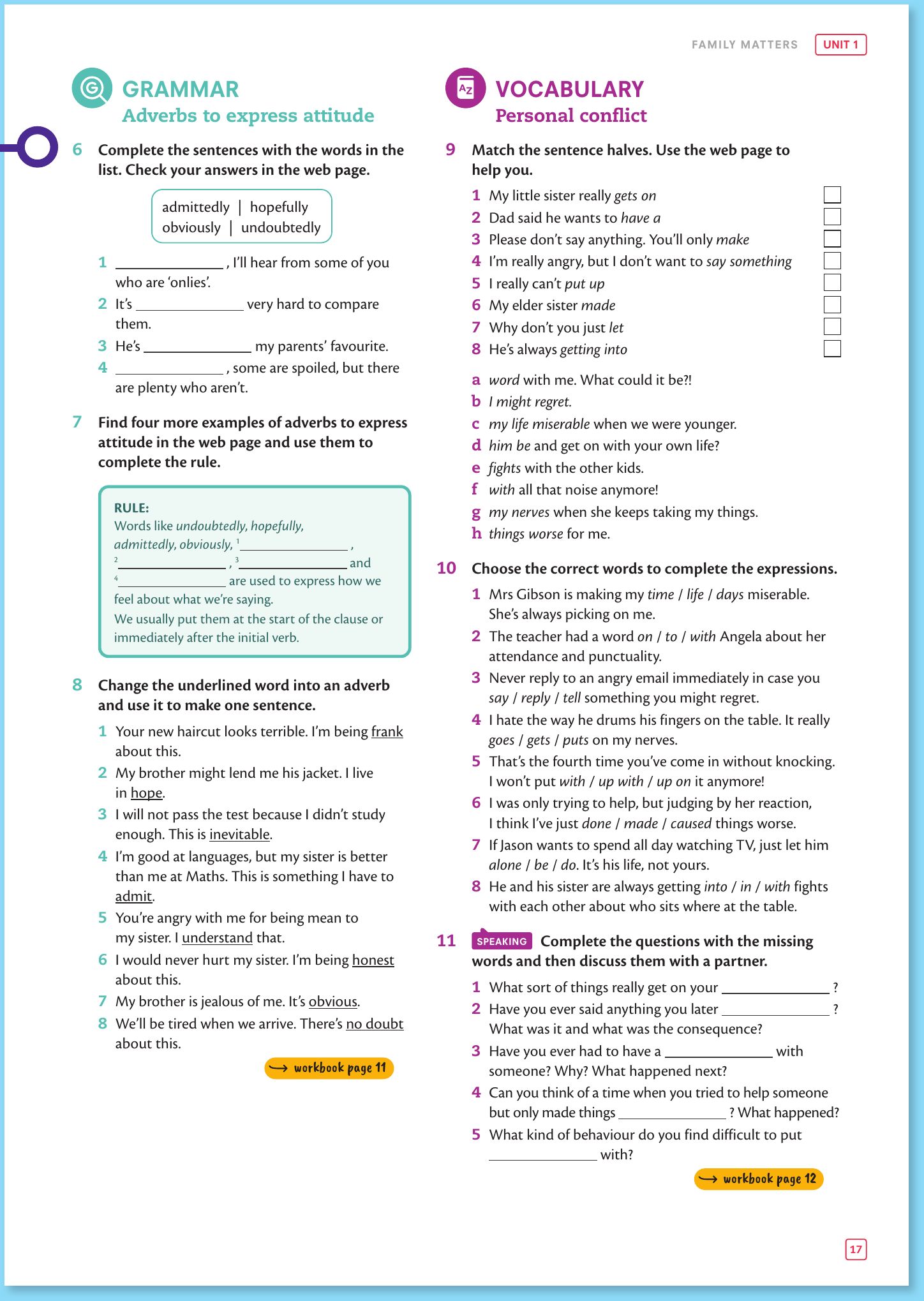
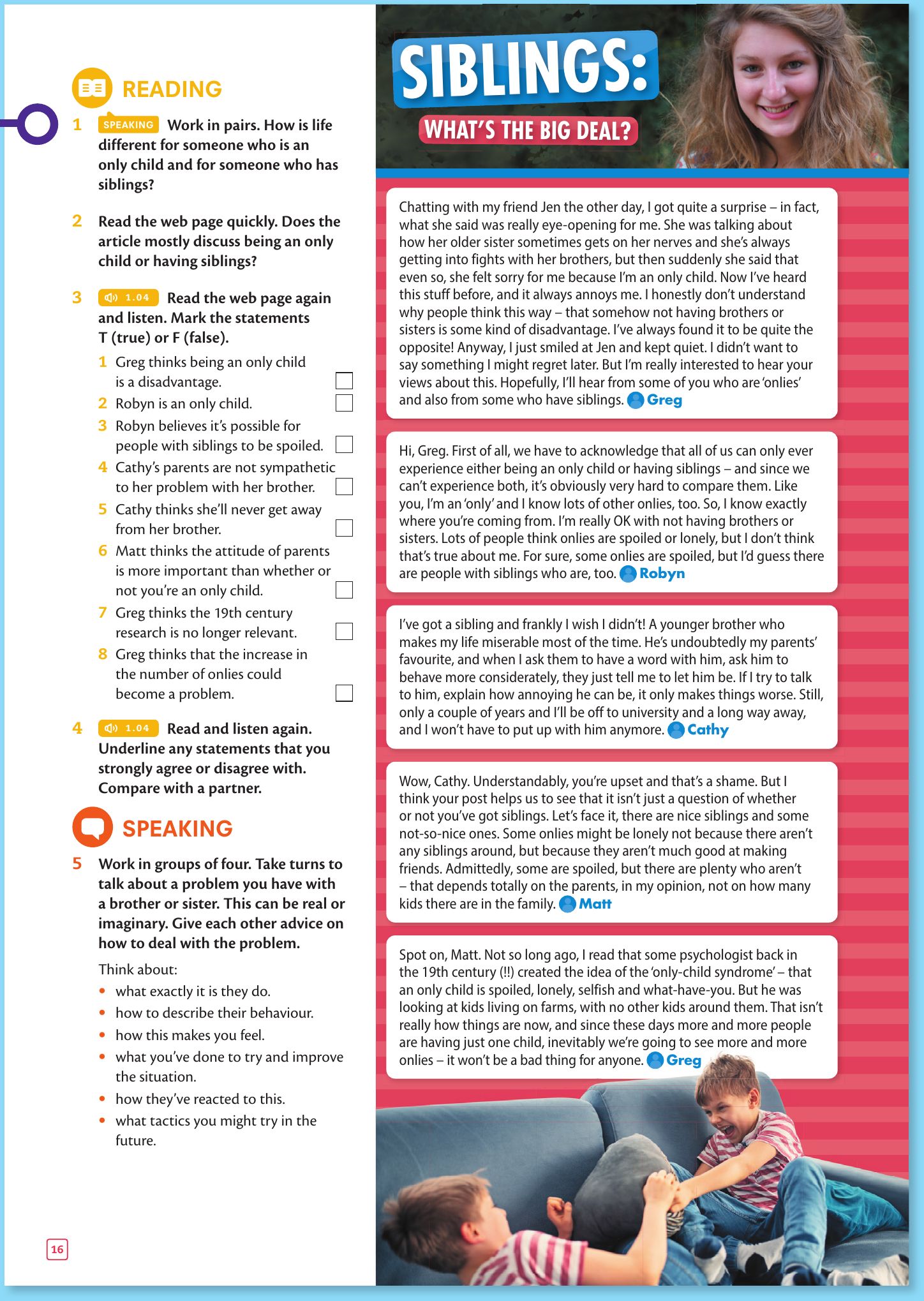
Choose the right word固定搭配选词 · 约 6 分钟 · Exercise 10 + Extension
Guiding questions
- Choose the correct word. Why are the other two wrong, even if they "make sense" in Chinese?
- Which of these situations have you actually been in?
- Extension: I say half a phrase, you say the whole thing. How fast can you go?
put up with · made things worse · let him be · getting into fights
中文"忍受"不分介词,英语必须 put up with;"让事情更糟"用 make,不用 do / cause;"说"后悔的话用 say(tell 后面要接人)。
1 life 2 with 3 say 4 gets 5 up with 6 made 7 be 8 into
按逻辑选会错,搭配是习惯:3 用 say,因为 tell 后面要接人;5 是 put up with(中文"忍受"不带介词,英语必须带);6 是 make things worse,不是 caused;7 let him be = 随他去。
课堂对话
Exercise 10. Same phrases, new sentences, and two wrong options for each. Choose fast. Number 1: Mrs Gibson is making my time, life or days miserable.
Life. Make my life miserable.
2: had a word on, to, or with Angela.
With.
3: say, reply or tell something you might regret.
Say.
Why not "tell"?
"Tell" needs a person after it. Tell someone something.
4: It really goes, gets or puts on my nerves.
Gets.
5: I won't put with, up with, or up on it anymore.
Up with.
6: I think I've just done, made or caused things worse.
Caused. Because I caused the problem.
Logically that makes total sense. But collocations aren't logic, they're habit. English speakers always say "make things worse".
Made. I think I've just made things worse.
7: just let him alone, be, or do.
Be. Let him be.
8: always getting into, in, or with fights.
Into. Getting into fights.
So: life, with, say, gets, up with, made, be, into. Now a speed game. I say half, you say the whole phrase. "Nerves!"
Gets on my nerves!
"Have a…"
Have a word with someone!
"Regret!"
Say something you might regret!
"Worse!"
Make things worse!
也可以两人一组互相考,一人说动词或名词,另一人说完整短语。
Now in pairs, test each other. Fastest pair wins.
Talk about your own conflicts聊真实冲突 · 约 9 分钟 · Exercise 11
Guiding questions
- Complete the five questions with the missing words.
- Discuss them with a partner. Give reasons. Listeners: keep asking follow-up questions.
- For question 2 or 4: if you could go back, how would you say it differently? Which adverb would you start with?
What really gets on my nerves is when people ___.
I once said something I later regretted: ___. Looking back, ___.
Follow-up: And then what happened? / How did they react? / Would you do it differently now?
第 3 轮输出:讲自己的冲突时至少用一个态度副词(admittedly / understandably / honestly)。
1 nerves 2 regretted 3 word 4 worse 5 up
Example: "Understandably, you want your own space, but it really gets on my nerves when you take my things without asking."
讨论部分开放。不开战的说法:先用 understandably 表示理解对方,再说行为,不评价人。admittedly 只能让自己让步,用来攻击别人还是攻击。
课堂对话
Exercise 11. First fill the gaps: nerves, regretted, word, worse, up. Easy now. Then discuss with a partner. Give reasons, and listeners, keep asking questions.
My example first. What really gets on my nerves is when people walk slowly in a line of three on a narrow pavement. Admittedly, I'm usually late, but still.
Ha! Same.
学生两人讨论 4 分钟。巡视,示范追问。
Let's hear one for question 2. Have you ever said something you later regretted?
Yes. I once told my sister she was the most selfish person I'd ever met.
And then what happened?
She didn't talk to me for a week.
Good follow-up question. Now, if you could go back, how would you say it?
I would say: Admittedly, you are a bit selfish.
Ha! "Admittedly" means YOU are admitting something against your own position. If you use it to attack her, it still sounds like an attack.
Oh. So: "Understandably, you want your own space, but it really gets on my nerves when you take my things without asking."
Now that's how you say something difficult without starting a war. You showed you understood her, then you described the behaviour, not her personality.
Question 3: I had to have a word with my best friend, because she was always cancelling our plans at the last minute.
Why? What happened next?
Honestly, she didn't even realise she was doing it. Now she texts me earlier.
And question 5? What behaviour do you find difficult to put up with?
I can't put up people who lie.
I think we all agree with you. But you lost a little word.
I can't put up with people who lie. Even small lies.
So, our big question. From everything today: what's the recipe?
Start with "understandably" or "admittedly", talk about the behaviour not the person, and maybe have a word in private instead of saying something you might regret.
Exit ticket出门票 · 约 5 分钟 · 回收主线 + Homework
Your task
- Write the difficult message you thought of at the start of the lesson, as you'd now say it to that family member (3–4 sentences).
- Use at least two attitude adverbs and two conflict phrases.
- Homework: write up your answers from Exercise 11, with as many collocations from Exercise 9 as possible.
Checklist:☐ understandably / admittedly / honestly / hopefully(at least two) ☐ two phrases from Ex.9 ☐ adverb in the right position ☐ behaviour, not personality
Mum, understandably, you want to know how I'm doing at school. Admittedly, my grades haven't been great this term. But honestly, it really gets on my nerves when you check my phone every evening, and I'm scared I'll say something I might regret. Could we have a word about it at the weekend? Hopefully we can find a way that works for both of us.
范文顺序:理解对方(understandably)→ 承认自己的问题(admittedly)→ 说出真实感受(honestly + gets on my nerves)→ 提议好好谈(have a word)→ 期待(hopefully)。
课堂对话
Exit ticket. Remember the difficult thing you thought of at the start? Write it now, the way you'd say it to that person. Three or four sentences, two adverbs, two phrases from Exercise 9.
写 3 分钟。可以匿名,不一定要读出来。
Anyone brave enough to share?
Mum, understandably, you want to know how I'm doing at school. Admittedly, my grades haven't been great. But honestly, it really gets on my nerves when you check my phone every evening.
Every adult in the room just felt that. And how do you finish?
Could we have a word about it at the weekend? Hopefully we can find a way that works for both of us.
That's not a war. That's a negotiation. Partner check: adverbs in the right position?
He wrote "I hopefully can find a way".
Where does the adverb usually go when there's a modal verb like "can"?
After the first verb, or at the start. "I can hopefully find a way", or "Hopefully, I can find a way".
Perfect. Homework: write up your answers to Exercise 11 with as many collocations from Exercise 9 as you can. Next lesson we go back two hundred years, to the most famous pair of sisters in English literature.
不开战的说话公式态度副词 + 冲突搭配
2 concede 让步→4 rewrite 改写→7 your conflict 聊真事→8 write 写下来