Three adjectives: who wrote them?热身 · 约 6 分钟 · Warmer + 收 p.13 作业
Guiding questions
- Write down three adjectives that describe your personality. Would your family choose the same three?
- Listen to the adjectives I read out. Who in the class wrote them? What made you guess that person?
- Was your guess based on what the person is, or on what they usually do?
- So how do we actually know someone's personality, if not through their habits?
It's got to be ___, because he/she ___.
先别管语法名称。今天的主线:性格 = 习惯的总和。别人说你 "outgoing",其实是在说你"总是/往往"做什么。
adjective → habit → evidence
We guessed by what people usually do: "she never panics", "he's always saying he'll do it later". Personality shows in our habits.
别人说你 outgoing、lazy,其实是在总结你的习惯。所以要描述性格,先得会说习惯,这就是这一页的语法。
课堂对话
Before anything else, last lesson's homework: your personality theory. Quick show of hands: who tested their theory on five people already? Keep the results, we'll use them later.
Now take a small piece of paper. Write three adjectives that describe your personality. No names. Fold it, pass it to me.
收纸条,随机读出 4–5 张。
First one: "This person is calm, sociable and intelligent." Who wrote it?
It's got to be Lily, because she never panics, even before exams.
Interesting. You didn't say "because she is calm". You said "because she never panics". Next: "This person is stubborn, loyal and lazy."
That's Max. He's always saying he'll do his homework later.
Max, is it you?
Guilty. But I'm not lazy, I'm efficient.
An efficient person who does the homework later. Noted. Now here's the question. Every time you guessed, did you talk about what the person IS, or what they usually DO?
What they usually do. Like "never panics", "always says later".
Because personality is show by habits.
That's the whole lesson in one sentence, nearly. Passive: is shown. Personality is shown by habits. Or even more naturally: "Personality shows in our habits."
Personality shows in our habits. You can't see "calm", but you can see someone who never panics.
Beautiful. So if personality is habits, we'd better be very good at talking about habits. And the big question today: which of your habits would your family complain about, and how would they say it?
My mum would say, "You're always on your phone!"
And notice how she'd say it: "always", with the -ing. Keep that line. It's on today's menu.
Four ways to talk about habits四种「习惯」结构 · 约 10 分钟 · Exercise 1 + RULE + Grammar video 02
Guiding questions
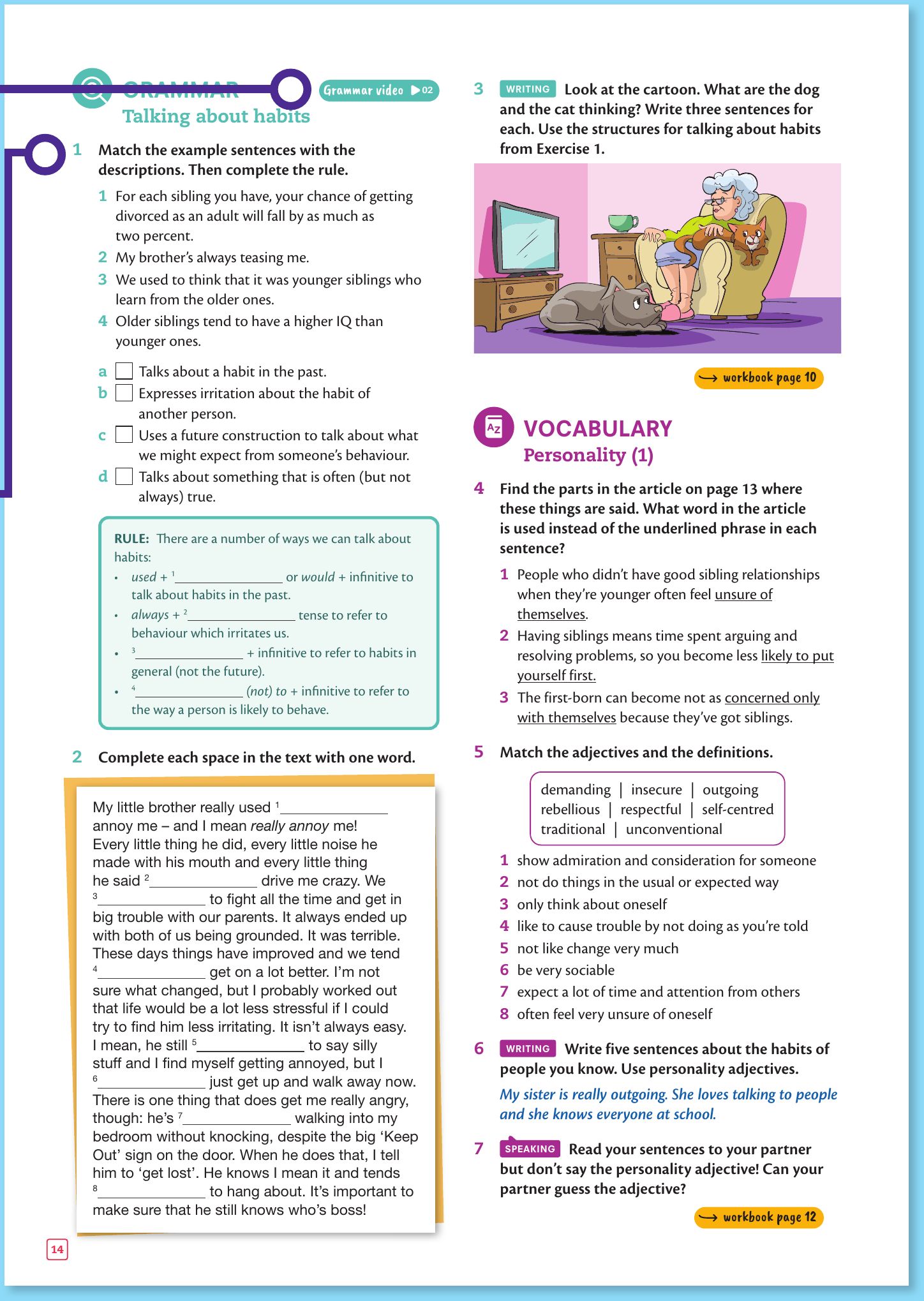
- Read sentences 1–4 (all from the article on p.13). Which words in each sentence refer to a habit?
- Sentence 1 uses will. Is it about the future? How do you know?
- Match 1–4 with descriptions a–d. Which one carries an emotion?
- Complete the RULE. Why does the rule say would + infinitive, but nothing about would for states?
- Extension: find more examples of will and tend to in the article.
| Form | Use | Example |
|---|---|---|
| used to / would + inf | past habits | We used to think… / He would hide my shoes. |
| always + present continuous | irritating behaviour | My brother's always teasing me. |
| will + inf | general habits, predictable behaviour (not future) | Your chance of divorce will fall by… |
| tend (not) to + inf | what someone is likely to do | Older siblings tend to have a higher IQ. |
will habit:She'll sit there for hours. = That's what she does.
1c 2b 3a 4d
RULE: 1 to 2 present continuous 3 will ('ll) 4 tend
Habit words: will fall by · 's always teasing · used to think · tend to have.
最容易错的是第 1 句:will 在这里不是"将来",而是"每次都会这样",描述可以预料的习惯。would 只能说过去反复的动作,不能说状态:I used to have long hair,不能说 I would have long hair。
课堂对话
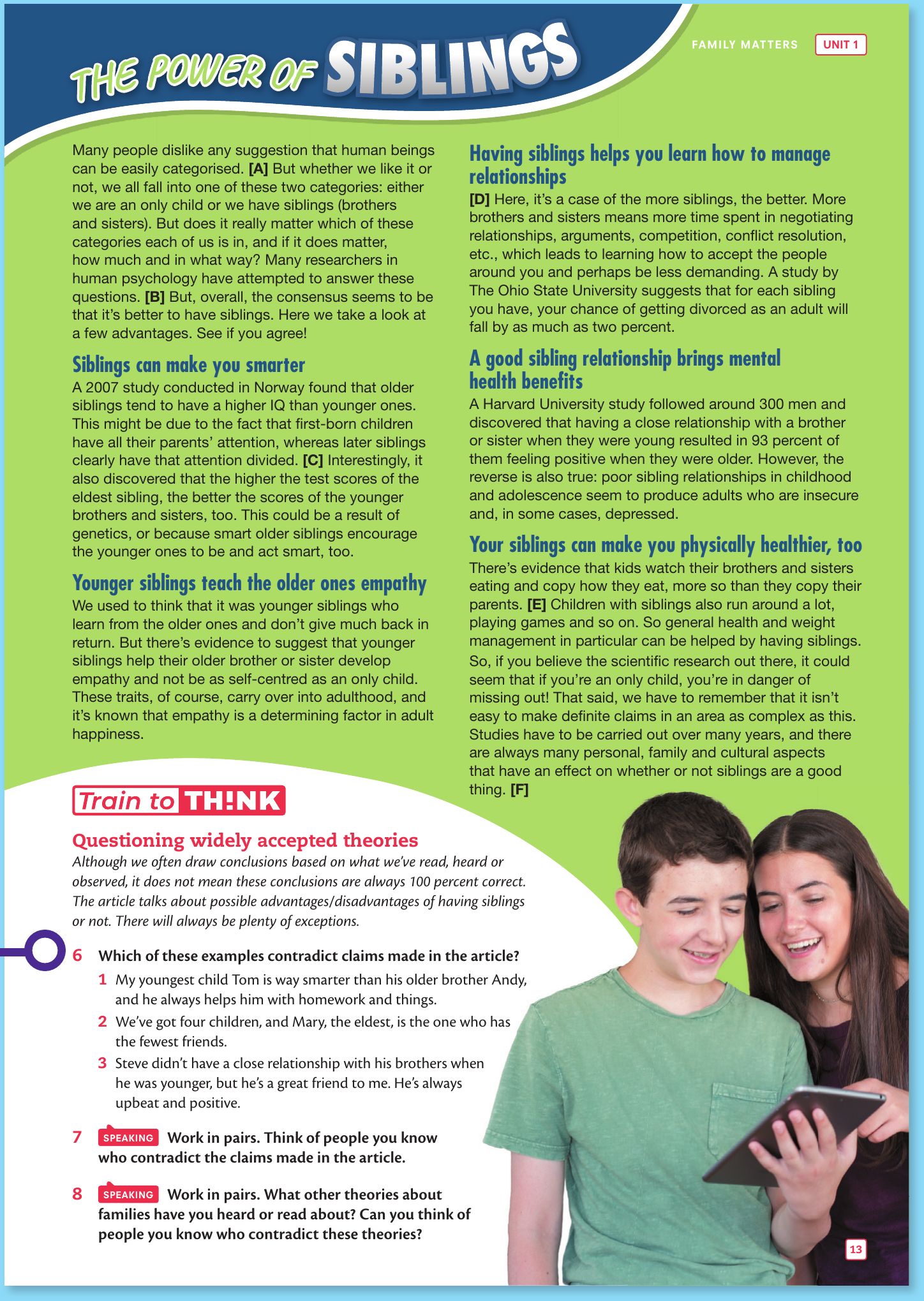
Grammar time, but you already know most of it. Sentences 1 to 4 in Exercise 1 are all from the article. Which words in each one refer to a habit?
"Will fall by", "'s always teasing", "used to think", and "tend to have".
Now sentence 1: "For each sibling you have, your chance of getting divorced as an adult will fall by as much as two percent." Is that a prediction about the future?
Yes, because "will" is future tense.
That's what every textbook taught us at first, I know. But read it again. Is it talking about one event next year, or about something that happens again and again, every time?
Every time. For every sibling, it happens. So it's more like a rule about behaviour, not about the future.
Exactly. That's description c: a future construction to talk about what we might expect. My grandma will sit in front of the TV for hours. Is that about tomorrow?
No, it's what she always does.
Now match the rest. Thirty seconds.
2 is b, irritation. 3 is a, a habit in the past. 4 is d, often but not always true.
So, 1c, 2b, 3a, 4d. Now the RULE box. Used plus…?
"To". Used to.
Always plus which tense?
Present continuous.
Gap 3: something plus infinitive for habits in general, not the future.
Will.
And gap 4: something "not to" plus infinitive.
Tend. Tend not to.
Now a trap the rule doesn't mention. Can I say "When I was little, I would have long hair"?
Yes, it's the same as "I used to have long hair".
Very reasonable guess, because for actions they're nearly the same. But "would" only works for repeated actions, not states. Have long hair, live in Beijing, be shy: those are states. So it's "I used to have long hair".
So "I would hide under the table when guests came" is fine, but "I would be shy" is wrong. It has to be "I used to be shy".
Perfect. Tiny Extension: go back to page 13. Find any more examples of will or tend to. Thirty seconds, go.
学生回到 p.13 找;可播放 Grammar video 02 巩固。
"Older siblings tend to have a higher IQ" and "your chance will fall". That's all I found.
Good. Let's use them now. One sentence each about your family, using "will" for a habit. "My dad will…"
My dad will fall asleep on the sofa at nine o'clock every single night.
One word per gap完形填空 · 约 8 分钟 · Exercise 2 + 发音
Guiding questions
- Read the whole text first. How has the writer's relationship with his brother changed?
- For each gap: past or present? Neutral or irritated? Positive or negative?
- Gap 8 comes after "tends". Why does the meaning force a negative?
- Say used to and tend to aloud. Where does the d and the t go?
Check:grounded = 被父母禁足(不许出门/没收手机的惩罚)· get lost = 走开(很不客气)· hang about = 赖着不走
1 to 2 would 3 used 4 to 5 tends 6 will / 'll 7 always 8 not
每空先判断:过去还是现在?中性还是抱怨?肯定还是否定?2 是一个词的空,used to 是两个词,所以用 would;6 说现在的固定反应,用 will;7 是全文最生气的一句,用 always + -ing;8 前面说 "He knows I mean it",所以他往往不会赖着不走 → tends not to。
课堂对话
Exercise 2. Before you fill anything in, read the whole text. How has the writer's relationship with his little brother changed?
They used to fight all the time, but now they get on better. But he still gets angry when his brother comes in without knocking.
Good. Now, quick check: "It always ended up with both of us being grounded". Grounded?
Your parents punish you. You can't go out, or they take away your phone.
Have you ever been grounded?
Yes, for a week, because I played games until three in the morning.
A week. 惨. Now the gaps, alone, three minutes. For every gap ask: past or present, neutral or irritated, positive or negative?
学生独立做 3 分钟。时间紧可以留作业。
Gap 1: "My little brother really used blank annoy me".
"To". Used to annoy.
Gap 2: "Every little thing he said blank drive me crazy."
Used. Every little thing he said used drive me crazy.
Grammatically you'd need "used to" there, two words, and it's one-word gaps. Which other past-habit word takes a bare infinitive?
Would. Every little thing he said would drive me crazy.
Gap 3: "We blank to fight all the time".
Used.
Gap 4, now present: "we tend blank get on a lot better".
To.
Gap 5: "he still blank to say silly stuff".
Tends. He still tends to say silly stuff.
Gap 6: "I blank just get up and walk away now". Present, predictable behaviour.
Will. I'll just get up and walk away now.
Gap 7, the one that really gets him angry: "he's blank walking into my bedroom without knocking".
Always. He's always walking into my bedroom.
And gap 8. "He knows I mean it and tends blank to hang about." Positive or negative?
Negative. If he knows I mean it, he leaves. So "tends not to hang about".
So: to, would, used, to, tends, will, always, not. Now pronunciation. Say "used to" naturally.
"Yoosta".
The d disappears, it's swallowed by the t. And "tend to"?
"Tenta".
Same thing. Keep those two sounds in your ear, because the next mistake lives right between "used to" and "use to".
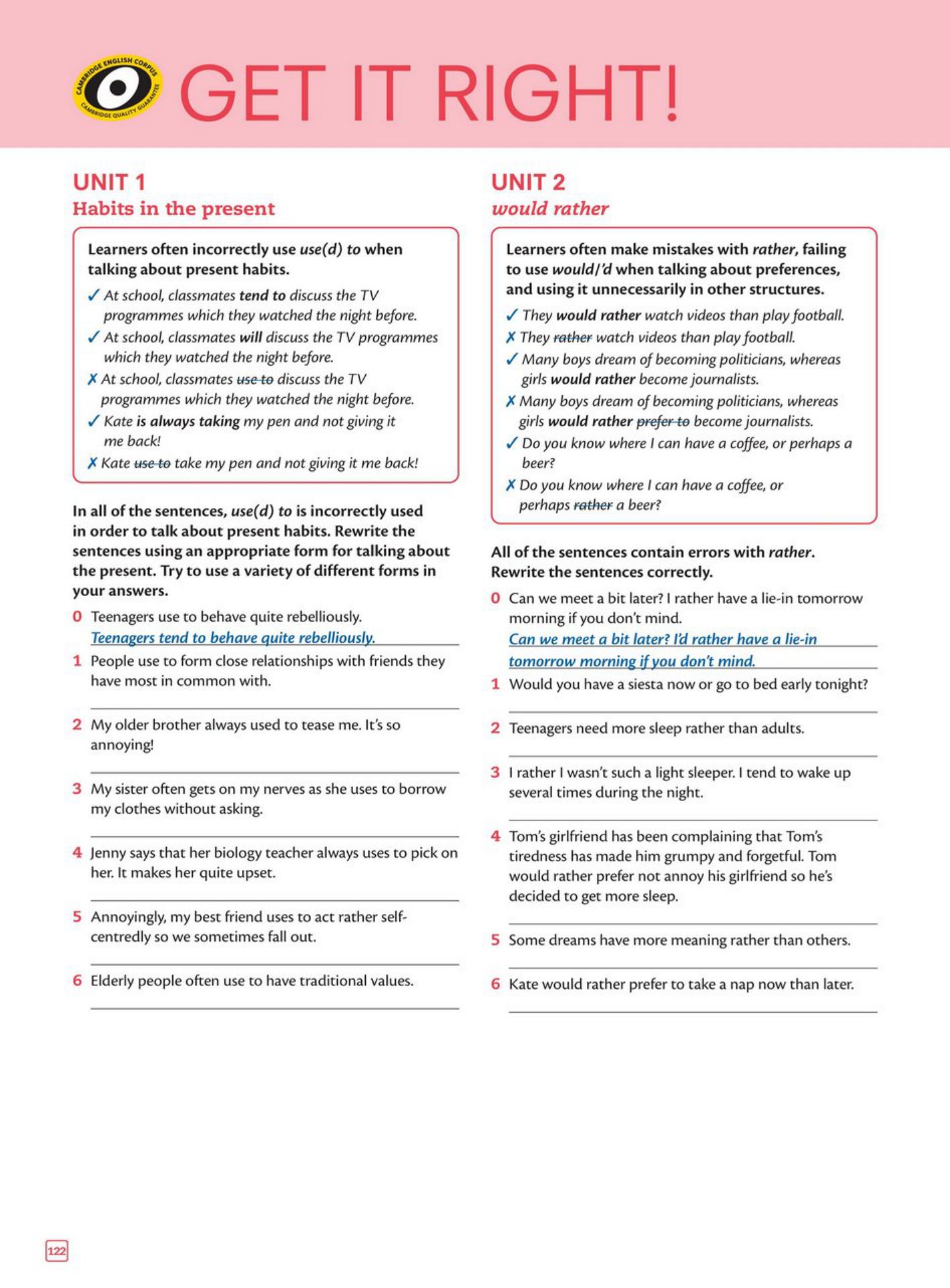
Get it Right! No more “use to”纠错 · 约 7 分钟 · Get it Right! p.122
Guiding questions
- Look at the box on page 122. Which two words are crossed out every time, and are the sentences about the past or the present?
- If used to only works for the past, which present-habit tools do we already have? (Look back at the RULE.)
- Which sentences are complaints? Which tool shows irritation best?
- Sentence 6 has have (values = a state). Can you say
are always having? What's left?
People tend to ___ . · She'll (often) ___ . · He's always ___-ing (and it drives me mad).
used to 只管过去,现在没有 use to。说现在的习惯:中性用 tend to / will,抱怨用 always + 进行时。have、know、like 这类状态动词不用进行时。
1 People tend to / will (often) form close relationships with friends they have most in common with.
2 My older brother is always teasing me. It's so annoying!
3 My sister often gets on my nerves as she will borrow / tends to borrow / is always borrowing my clothes without asking.
4 Jenny says that her biology teacher is always picking on her. It makes her quite upset.
5 Annoyingly, my best friend tends to act rather self-centredly so we sometimes fall out.
6 Elderly people will (often) have / tend to have traditional values.
六句说的都是现在,所以 use(d) to 全错。1、5、6 是客观陈述,用 tend to 或 will 最自然。2、4 后面跟着 "so annoying""makes her upset",是抱怨,用 always + 进行时最传神。3 三种都对,语气不同:will borrow 平静,is always borrowing 带火气。6 的 have 是状态(拥有价值观),不能说 are always having,所以只剩 will have / tend to have。5 已经有 Annoyingly 表达不满,tends to act 就够了,不必再叠 always。
课堂对话
Confession time. Who has ever said "I use to get up at six"? Be honest.
Me. Many times.
You're in good company. It's so common that the book has a whole page on it. Page 122, Unit 1. Look at the crossed-out words in the box. What are they?
"Use to". Every time.
And are those sentences about the past or the present?
The present. Classmates discuss the TV programmes, Kate takes my pen. It's happening now.
So what's the problem with "use to" for now?
It should be "used to"? Classmates used to discuss the TV programmes.
Grammatically fine, but now you've moved it into the past. Maybe they don't do it anymore. The writer means they still do it. So which tools do we have for present habits?
Tend to, will, and always with the continuous.
Your whole toolbox from the RULE. Now six sentences, all with the same disease. Rewrite them, and try to use different tools. Three minutes.
学生独立改写 3 分钟,然后同桌互查:每人至少用到三种结构。
Number 1: "People use to form close relationships with friends they have most in common with." Is this a complaint?
No, it's a general fact. People tend to form close relationships with friends they have most in common with.
Number 2: "My older brother always used to tease me. It's so annoying!"
My older brother is always teasing me. It's so annoying!
Why always plus continuous here?
Because of "so annoying". It's a complaint, and that form sounds irritated.
Number 3, the sister and the clothes. Give me two versions.
She'll borrow my clothes without asking. Or: she's always borrowing my clothes without asking.
Which one sounds angrier?
"She's always borrowing." The first one is calmer.
Number 4, Jenny's biology teacher.
Her biology teacher is always picking on her. It makes her quite upset.
Number 5: "Annoyingly, my best friend uses to act rather self-centredly."
My best friend tends to act rather self-centredly, so we sometimes fall out.
And the last one, number 6. "Elderly people often use to have traditional values."
Elderly people are always having traditional values.
I like that you reached for a new tool. But "have" here is a state, like "know" or "like". Do we usually put states in the continuous?
No. So: elderly people tend to have traditional values. Or: elderly people will often have traditional values.
Perfect. Now one about your own family, present tense, no "use to" allowed.
My dad will always check the weather app before he leaves the house, even when he's only going downstairs.
My little sister is always stealing my snacks. 我的辣条从来活不过一天.
Ha, a tragic story. Habits like that are exactly what families complain about. Keep them, you'll need them for the comic next.
What are the dog and the cat thinking?漫画写作 · 约 8 分钟 · Exercise 3
Guiding questions
- Look at the cartoon. Who's in the comfortable place, and who isn't? How do you know they're feeling different things?
- What's probably happened in this house every evening for years?
- The dog is annoyed. Which structure gives you the annoyed voice? The cat is smug. Which structures suit a calm, "this is how things are" voice?
- Write three sentences for each animal. Did you use at least three different habit structures? Did you check positive vs negative?
Dog: "She's always letting that cat…"irritation 吐槽
Cat: "She'll stroke me for hours."smug habit 得意
Dog: She's always ___ing… / I used to ___, but now ___. / She tends not to ___.
Cat: Every evening she'll ___. / Dogs tend to ___. / He's always ___ing — so embarrassing.
第 1 轮输出:同一个结构不要用两次;注意 tend not to 和 never 的语气区别。
Dog: I used to be the one on her lap, but now I'm stuck on the floor. She's always choosing that cat over me! She tends not to notice me until it's time for my walk.
Cat: Every evening she'll stroke me until she falls asleep. Dogs tend to be so needy. He's always sighing on the carpet, which is frankly a little embarrassing.
开放题。狗在吃醋,用 always + -ing 吐槽;猫很得意,用 will、tend to 平静地讲"本来就这样"。三句用三种不同结构,语气对就算对。
课堂对话
Exercise 3. Look at the cartoon. Describe the scene in one sentence.
An old lady has fallen asleep in an armchair in front of the TV, with a cat on her lap, and a dog is lying on the floor looking miserable.
Who's got the best seat in the house?
The cat, obviously. It's on her lap and it looks very pleased with itself.
Smug, that's the word. And the dog?
Jealous. He's lying on the floor with a sad face.
Now think in habits, not in this one moment. What has probably happened in this house every evening for years?
The lady will watch TV, fall asleep, and the cat will sleep on her lap.
Lovely, that's the habitual "will". Which voice does the dog need?
The annoyed one: "always" with the continuous.
And the cat, who's perfectly happy with the situation?
"Will" and "tend to". Calm, like it's a fact of life.
Three sentences for each animal, and at least three different structures. Quick reminder: check whether you need positive or negative. Four minutes.
巡视,提醒 tend not to 的位置;强的学生加一个 used to 对比过去。
Dog first. Who's got a good one?
I used to be the one on her lap, but now I'm stuck on the floor.
And she is always choose that cat over me!
The jealousy is perfect, the grammar needs one more letter-group. Is always… choosing.
She's always choosing that cat over me!
Much more bitter. One with "tend not to"?
She tends not to notice me until it's time for my walk.
Ouch. Now the cat, and make it smug.
Every evening she'll stroke me until she falls asleep. Dogs tend to be so needy.
And the dog would sigh on the carpet every evening, so annoying.
Very cat-like attitude. But "would" puts it in the past, and this is still happening. For a present habit that annoys the cat?
He's always sighing on the carpet. So embarrassing.
Now who's ready to read both, in two different voices?
Find the word in the article原文找词 · 约 6 分钟 · Exercise 4 reading race
Guiding questions
- Reading race: find where sentences 1–3 are said in the article on p.13. Which paragraph?
- What single word does the article use instead of the underlined phrase?
- Why does the article use one word, and the exercise use a longer phrase? What does that tell you about academic style?
先找主题(关系差 → mental health 段;吵架解决问题 → relationships 段;老大 → empathy 段),再在段内找形容词。
likely to put yourself first → demanding
concerned only with themselves → self-centred
1 insecure("adults who are insecure")
2 demanding("perhaps be less demanding")
3 self-centred("not be as self-centred as an only child")
先按话题找段落(关系不好 → mental health 段;吵架 → relationships 段;老大 → empathy 段),再在段里找形容词。注意是 demanding(爱提要求的人),不是 demanded。
课堂对话
Exercise 4, and it's a race: three paraphrases, find the original word on page 13. First pair with all three, hands up. Go!
计时,最快的一组举手后全班核对。
Done!
Number 1: "People who didn't have good sibling relationships when they're younger often feel unsure of themselves." Which paragraph, and what word?
The mental health one. "Adults who are insecure". So insecure.
Number 2: "so you become less likely to put yourself first".
"Less demanded."
Right paragraph, right root, wrong ending. "Demanded" is a past participle, something that was asked for. We need the adjective for a person who asks a lot.
Demanding. "Perhaps be less demanding."
Number 3: "not as concerned only with themselves".
Self-centred. "Not be as self-centred as an only child."
How did you find them so fast?
I looked for the topic first, then for an adjective inside that paragraph.
That's the method. Topic, then word class. Now, why does the article use one word when the exercise needs six?
Because it's more academic. One precise word is shorter and sounds more expert.
Exactly. And that's what C1 vocabulary does: one exact word instead of a description. Next exercise, eight more.
Eight personality adjectives性格词 · 约 9 分钟 · Exercise 5 + 重音 + Mixed-ability
Guiding questions
- Mixed-ability: cover the definitions. With a partner, try to define each word first. Which ones can you build from their parts (un-, in-, self-, -ful)?
- Match the adjectives with definitions 1–8.
- Which of these words are compliments, which are criticisms, and which depend on who's speaking?
- Where's the stress in each word?
| Adjective | Stress | Watch out |
|---|---|---|
| respectful | reSPECTful | ≠ respectable 体面的 |
| unconventional | unconVENtional | 不走寻常路(多为中性/褒) |
| self-centred | self-CENtred | US: self-centered |
| rebellious | reBELlious | 动词 reBEL,名词 REbel |
| traditional | traDItional | 不喜欢变化 |
| outgoing | outGOing | = very sociable |
| demanding | deMANding | a demanding job / boss / child |
| insecure | inseCURE | ≠ unsafe |
"Rebellious" for a teenager = criticism? or compliment?
1 respectful 2 unconventional 3 self-centred 4 rebellious 5 traditional 6 outgoing 7 demanding 8 insecure
易混:respectful 是"对别人尊重",respectable 是"体面、值得尊重"。rebellious 重音在第二音节 re-BEL-lious。
课堂对话
Exercise 5. Eight adjectives. Here's a trick: cover the definitions first. With your partner, define as many as you can from the word itself. Two minutes.
学生遮住定义互相解释;然后再看定义匹配。
Which ones could you build from their parts?
Unconventional: "un" plus conventional, so not normal or not usual. Self-centred: the centre is yourself.
Good. Now uncover and match. One minute.
Number 1: show admiration and consideration for someone.
Respectable.
Close, and a very common mix-up. "Respectable" means other people respect you: a respectable job, a respectable family. We need the person who shows respect.
Respectful. She's always respectful to her grandparents.
Good. 2, not do things in the usual way?
Unconventional.
3, only think about oneself: self-centred. 4, like to cause trouble by not doing as you're told?
Rebellious.
5, not like change very much: traditional. 6, be very sociable: outgoing. 7, expect a lot of time and attention from others: demanding. 8, often feel very unsure of oneself?
Insecure. From the article.
Now pronunciation. Say them after me and tell me where the stress is. Rebellious.
re-BEL-lious.
And unconventional?
un-con-VEN-tion-al.
逐个领读,在黑板上标重音。
Now the interesting part. Compliments, criticisms, or it depends? Unconventional?
It depends. My grandparents would say it as a criticism, but my friends would say it as a compliment.
And rebellious?
For parents it's a criticism. But in films, the rebellious one is usually the hero.
My mother says I'm too demanding, because I always ask her to buy new clothes.
A very honest example! One thing: "always ask" is just a fact. If your mum is complaining, how would she say it?
"You're always asking me to buy you new clothes!" So she thinks I'm demanding.
There's our big question again. Your family complains about a habit, and the habit becomes an adjective.
Describe without the adjective写习惯、猜形容词 · 约 9 分钟 · Exercise 6 + 7
Guiding questions
- Write five sentences about the habits of people you know. Use five different adjectives and try to use four different habit structures.
- Read your sentences to your partner without the adjective. Can they guess it?
- If they guessed wrong, was it your evidence or their interpretation?
- Do these people fit the theories in the article on p.13? Who's an exception?
My ___ is really [adjective]. She'll ___ / He's always ___ing / She tends to ___ / He used to ___ but now ___.
第 2 轮输出:五句里至少用到 will / always -ing / tend (not) to / used to·would 中的四种。范例:My sister is really outgoing. She loves talking to people and she knows everyone at school.
My grandad is really traditional. He'll eat exactly the same breakfast every day, and he tends not to trust anything new.
My cousin is quite rebellious. She used to dye her hair a different colour every month.
My little brother is so demanding. He's always asking me to play with him the minute I get home.
My best friend is outgoing. She'll start a conversation with anyone on the bus.
My uncle is a bit insecure. He tends to ask everyone what they think before he makes any decision.
开放题。好句子让习惯本身成为证据,同桌不看形容词也能猜出来。同一个习惯可能被理解成两种性格(比如 insecure 和 respectful),这很正常。
课堂对话
Exercise 6. Five sentences, five people, five different adjectives. And the challenge: try to use four different ways of talking about habits. Here's the model in the book: "My sister is really outgoing. She loves talking to people and she knows everyone at school."
Five minutes. Write it so the habit is the evidence.
巡视,帮学生选准形容词;检查 would 是否用在状态动词上。
Exercise 7. Read your sentences to your partner, but replace the adjective with a "beep". Partner guesses.
My grandad is really beep. He'll eat exactly the same breakfast every day, and he tends not to trust anything new.
Traditional!
Easy, the evidence was perfect. Next.
My cousin is beep. She'll talk to anyone at a party, even people she's never met.
Rebellious?
Hm, does talking to strangers break any rules? What's the word for someone who's very sociable?
Outgoing. She's outgoing.
Right. And who has a tricky one?
My uncle is beep. He tends to ask everyone what they think before he makes any decision.
Respectful? Because he respects other people's opinions?
Ooh, interesting. Is that a wrong guess, or just a different interpretation?
Different interpretation. I meant insecure, because he's never sure of himself.
So the same habit can be read as two personalities. That's exactly why the article had to say "seem to" and "tend to". Last question: do your people fit the article's theories?
My little brother is demanding, and he's the youngest. The article says older siblings are the self-centred ones, so he's kind of an exception.
Because he is the youngest, so he is demanding.
Your logic's clear, but English doesn't use "because" and "so" together in one sentence like 因为…所以. Pick one.
He's demanding because he's the youngest. Or: he's the youngest, so he's used to getting what he wants.
Exit ticket出门票 · 约 5 分钟 · 回收主线
Your task
- Which of your habits would your family complain about? Write it as a family member would say it.
- Then write 2–3 sentences in your own voice: what you used to do, what you tend to do now, and which adjective they'd use for you.
- Is the adjective fair? One sentence.
Checklist:☐ always + -ing (their voice) ☐ used to or would ☐ tend (not) to or will ☐ one adjective from Ex.5
My mum: "You're always leaving your cups all over the house!" I used to leave them in my room, so at least now she can see them. I'll usually collect them before dinner, but I tend to forget the one in the bathroom. She'd probably call me self-centred, but I think "busy" is a fairer word.
范文用了四种结构:always -ing(妈妈的吐槽)· used to(过去)· will(现在的习惯)· tend to(倾向)。
课堂对话
Exit ticket. Back to the big question: which of your habits would your family complain about? First line: write it exactly as they'd say it.
"You're always leaving your cups all over the house!"
I can hear your mum. Then two or three sentences in your own voice. Past, now, and the adjective. Is it fair?
写 3 分钟,同桌交换按 checklist 检查。
I used to leave them in my room, so at least now she can see them. I'll usually collect them before dinner, but I tend to forget the one in the bathroom. She'd probably call me self-centred, but I think "busy" is fairer.
Ha! Defence lawyer. Partner check: four structures?
He wrote "I would be very messy when I was a kid".
Which rule did that break?
"Would" can't be used with a state. "Be messy" is a state, so it's "I used to be very messy".
Exactly. Today: personality shows in habits; we have four tools to describe them, one for complaining; and eight adjectives that turn habits into labels. Next lesson: what happens when the complaining turns into a real argument.
四种习惯结构说、写、吐槽、猜
2 family "will" 说家人→4 dog & cat 续写→7 guess the adjective 聊真人→8 write 写下来