Warmer + video热身 · 约 6 分钟 · Warmer + Get Thinking 01
Guiding questions
- Who or what has had the most important influence on your personality: parents, siblings, friends or school? You may only pick one.
- Is that influence something they did on purpose, or something you absorbed without noticing?
- If it was absorbed, could the same "influence" have worked on you if you'd grown up as an only child, or with three siblings?
- Watch the video. Is having a sibling a good thing, and for whom: the child, the parents, or the adult the child becomes?
- Where do you stand right now: real difference, just a label, or it depends? What would change your mind?
The biggest influence on who I am has probably been ___, not so much because of what they said as because of ___.
I'd say it's a real difference / mostly a label, but I could be persuaded otherwise if ___.
influence on sb(不是 to)· have an influence on = influence sb(动词不加 on)· sibling 兄弟姐妹的统称
My position now: ____ Position at the end: ____
The biggest influence on who I am has probably been my dad, not so much because of what he said as because of what he did: I grew up watching him plan everything, and now I can't start anything without a list.
开放题,没有标准答案。好的回答有两点:① 只选一个影响;② 说清楚它怎么影响你(模仿、竞争、关注多少),而不只是"我妈对我影响很大"。有理有据就算对。
课堂对话
Morning, everyone. Before we open anything, a slightly uncomfortable question: the person you are right now, the way you argue, the way you share, or don't, how much of that did you choose?
Here's the warmer on the board. Who or what has had the most important influence on your personality? Parents, siblings, friends, school. One answer only. 不许端水。
Two minutes with your partner. And don't just name the influence. Tell me how it got into you.
I think my father has a very big influence to me, because he is very strict.
Strict dads, a classic. The idea's clear, the preposition isn't. Influence ON someone. And if you use it as a verb, there's no preposition at all: he influenced me. Run it again, and add the "how".
My father has had a huge influence on me. He never told me to be organised, but I grew up watching him plan everything, so now I can't start anything without a list.
That's the interesting bit. He didn't do it on purpose. You absorbed it. Who else picked something they absorbed rather than something they were taught?
Me. I picked my friends. I didn't decide to talk like them, but I definitely do now.
So the influence was invisible, until you looked back. Now push it further. If you'd grown up as an only child, or with three noisy brothers, would that same influence have worked on you in the same way?
Probably not. With three brothers my dad wouldn't have had time to be so strict with me.
Interesting: so the number of kids changes how the parents behave, which then changes you. Hold that thought. It'll come back in the article.
Now the video. The question is simple, but listen for one thing: when people say having a sibling is "good", good for whom? The child? The parents? The adult later?
播放 Get Thinking 视频 01。没有视频的班级跳过,直接进入下一句讨论。
So, good for whom?
Mostly for the child, I think. They said you learn to share and to deal with arguments.
That's one benefit. Did anyone hear a cost?
Someone said you have to compete for attention all the time.
Right, so even in two minutes of video, it's not one-sided. Last thing. Where do you stand right now? Option one: there's a real difference between only children and people with siblings. Option two: it's mostly a label, a box. Option three: it depends.
I think it's depend on the family.
"It depends" is a very C1 answer, and I respect it. Grammar check, though: depend is the verb, so there's no "is". It depends on the family. And now I'm going to be annoying: depends on WHAT about the family?
It depends on how the parents treat each child, and maybe on the age gap.
Much better, that's a position with a mechanism. Write your position on the board line: real difference, label, or it depends, plus one reason. At the end of the lesson I'll ask you again, and you'll need a better reason than "I feel like it".
Give the photos a voice看图配音 · 约 9 分钟 · Exercise 1
Guiding questions
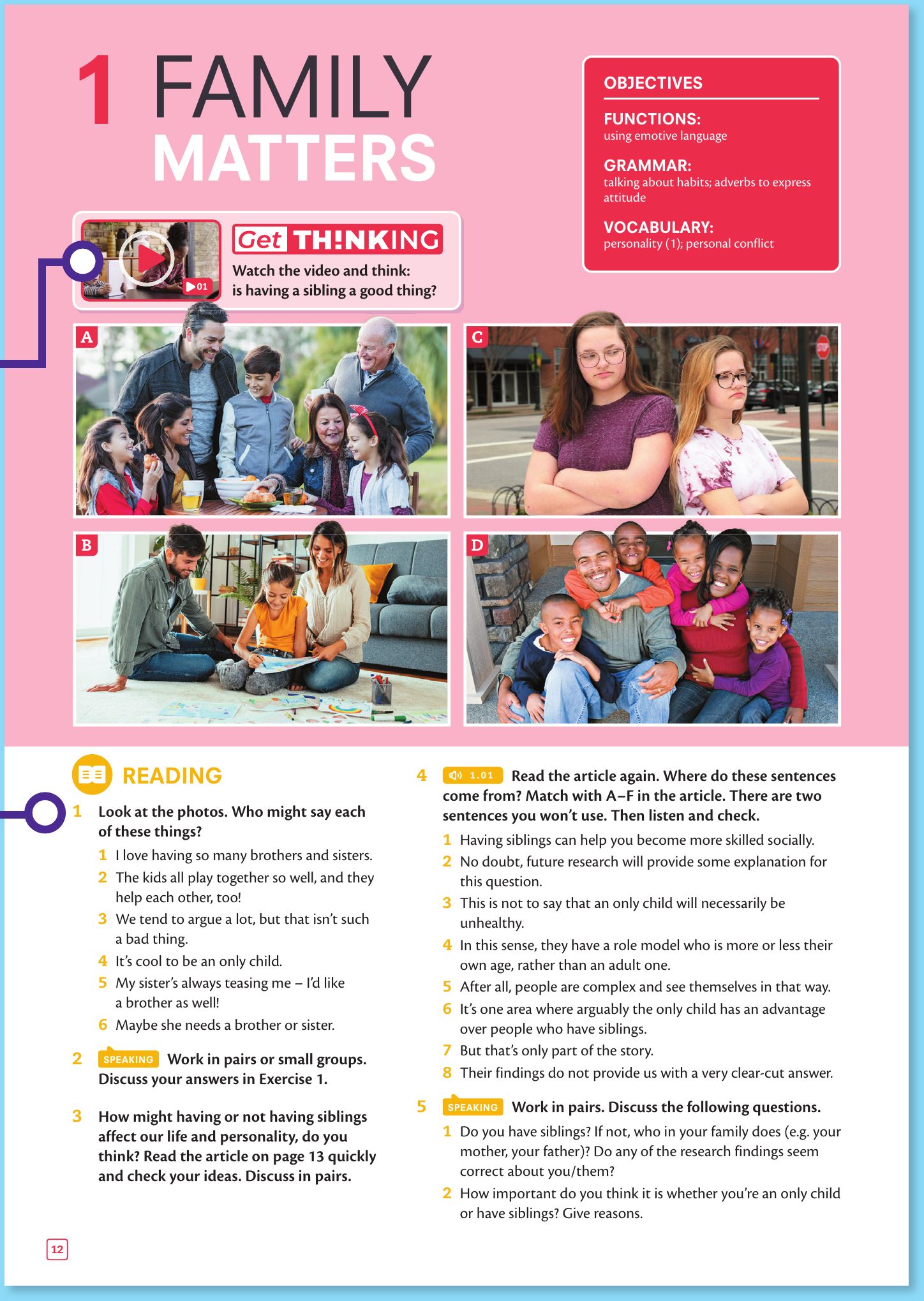
- Photos A–D: what's the relationship between the people? What exactly in the image makes you say so?
- Read statements 1–6. Who might say each one? Which word in each statement is your best clue?
- Statement 3 says "We tend to argue". Statement 5 says "My sister's always teasing me". Both describe a habit. Which one sounds annoyed, and why?
- Statements 4 and 6 are about the same child. Who's right, the child or the parent? Is that even a fair question?
| Statement | Clue to listen for |
|---|---|
| 1 I love having so many brothers and sisters. | quantity + "brothers and sisters" = speaker is a child |
| 2 The kids all play together so well… | "the kids" = speaker is watching from outside: an adult |
| 3 We tend to argue a lot, but that isn't such a bad thing. | body language of conflict; a calm attitude to it |
| 4 It's cool to be an only child. | the one photo with one child |
| 5 My sister's always teasing me – I'd like a brother as well! | has a sister, no brother; complaining |
| 6 Maybe she needs a brother or sister. | "she" ≠ speaker: someone talking about a child |
Judging by ___, they're probably ___. / The give-away is ___.
I tend to ___ when ___. My ___ is always ___ing!
tend to + 动词原形 = 中性地说"往往会";be always + -ing = 带情绪的"老是"。这两个结构 p.14 会系统讲,今天先会用。
be always + V-ing → irritation 吐槽
1 → D, one of the children (A is also possible)
2 → A, a grandparent or parent (or the dad in D)
3 → C, one of the two girls
4 → B, the girl
5 → C, one of the girls (or a girl in D)
6 → B, the mum or the dad, about their daughter
线索词:1 so many brothers and sisters(孩子才这么说兄弟姐妹)· 2 the kids(从外面看孩子的是大人)· 3 we argue(C 两人抱臂冷战)· 4 only child(B 只有一个孩子)· 5 有姐妹、想要个兄弟,而且 always teasing 是在抱怨 · 6 she 不是说话人,是父母在谈女儿。照片题允许不同理解,有理有据就算对。
课堂对话
Books open, page 12. Four photos. Before you read a single word, give me relationships, not descriptions. Photo A: who are these people to each other, and what's the give-away?
They're probably three generations of one family. The give-away is the older man and woman at the same table as the kids, and everyone's eating together.
"The give-away is…" Nice. Photo C?
Judging by their faces, they're probably sisters who've just had an argument. They've both got their arms crossed and they're looking away from each other.
Two teenagers, mutual silence. 冷战现场. And B?
Two parents and one girl. She might be an only child.
"Might be". Good, because a photo can't prove that. Now Exercise 1: six statements, four photos. Work out who might say each one. The skill here is the clue word. Number 1, "I love having so many brothers and sisters". Clue?
"So many", and "brothers and sisters". An adult would say "children", so it's one of the kids in D.
Number 2: "The kids all play together so well." Why can't a kid say this?
Because "the kids" sounds like someone outside the group. It's a parent or a grandparent in A.
Exactly, it's the view from the adult table. Number 3: "We tend to argue a lot, but that isn't such a bad thing."
Photo C. They're arguing, but she's saying it isn't a disaster.
Now, "tend to". If I say "I tend to overthink things", does that mean every single time?
No, it means it's my usual pattern, but not always.
Right. Give me one true pattern of yours. "I tend to… when…".
I tend to playing my phone when I should be studying.
Painfully relatable. Two things, though. After "tend to" it's the base verb, no -ing. And you play ON your phone, not "play your phone". Again?
I tend to play on my phone when I should be studying.
Number 4 is easy: "It's cool to be an only child". B, the girl. Now listen to number 5 with my voice. "My sister's ALWAYS teasing me." Compare: "My sister teases me." Which one is a complaint?
The first one. "Always" with the continuous makes it sound like it drives her crazy.
That's the 吐槽 tense. Your turn: one person, one annoying habit, full emotion.
My roommate is always forget to close the door!
I believe you, and I'm on your side. But "is always" needs the -ing form after it. Is always forgetting.
My roommate is always forgetting to close the door!
Better, and angrier. Number 6: "Maybe she needs a brother or sister." Is "she" the speaker?
No, someone's talking about her. It's the mum or dad in B, about their daughter.
So look: number 4 and number 6 are the same family. The girl says it's cool. The parents think she's missing something. Who's right?
You can't really say. It's her experience against their worry.
And that's our big question in miniature: is "only child" a real difference, or is it a box the parents are worried about?
Defend your match + add a line小组辩答案 · 约 6 分钟 · Exercise 2 + Extension
Guiding questions
- In groups, compare your answers to Exercise 1. Only discuss the ones where you disagree.
- Whose evidence is stronger: a word in the statement, or something in the photo? Can both be true?
- Extension: add one more sentence to each statement to expand on the speaker's viewpoint. What would they say next?
- Read only your added line. Can the group work out which statement it belongs to? What gave it away?
I'd put it under ___, mainly because ___.
I see where you're coming from, but ___. / That's a fair point; I hadn't noticed ___.
第 2 轮输出:续写的六句里至少两句用 tend to 或 be always -ing。反驳时先承认对方,再给证据。
1 …There's always someone to talk to, even at two in the morning.
2 …They tend to sort out their own arguments before we even notice.
3 …We always end up laughing about it the next day.
4 …I get my parents' full attention, and nobody steals my stuff.
5 …She's always reading my messages over my shoulder.
6 …She tends to spend too much time with adults.
续写要接得上原句的态度:5 是抱怨,所以用 always + -ing;2 是大人平静地描述,所以用 tend to。内容可以不同,语气和结构对就算对。
课堂对话
Exercise 2. Groups of three or four. I'm not interested in the answers you agree on. Find the ones where you disagree, and settle them with evidence.
小组讨论 2 分钟,巡视,只听分歧点。
Group 2, you had a fight about number 5.
I put it under D, because there are lots of girls in D and one could be complaining about her sister.
I am not agree. She says she'd like a brother, but in D there are already brothers.
Strong evidence, and I like the energy. But "agree" is already a verb, so no "am". And at C1 we can disagree more elegantly: "I see where you're coming from, but…". Try it.
I see where you're coming from, but she says she'd like a brother as well, and the girls in D already have brothers. So it fits C much better.
See what happened? The photo evidence said "maybe D", the language evidence said "definitely not D". When they clash, which wins?
The language, because it's what the person actually says.
Fair. Now the Extension. Real people don't speak in single sentences. Add one more line to each statement, something that expands on the speaker's point of view.
Example. Number 2, the grandparent: "The kids all play together so well." What comes next?
They tend to sort out their own arguments before we even notice.
Lovely, and you slipped "tend to" in. That's the challenge: at least two of your six lines must use "tend to" or "is always -ing". Three minutes.
巡视。弱一点的同学可以只写 3 句,但必须用对结构;强的同学可以给每个人物加一个态度。
Game time. Read me only your new line. Everyone else, tell me the number and what gave it away.
She's always reading my messages over my shoulder.
Number 5! "Always reading" is a complaint, and it's about a sister.
Correct, and it sounded properly irritated. Another one?
She tends to spend too much time with adults.
Number 6. It's the parents worrying about the only child again.
Notice that? The parents' worry has a specific shape. Not "she's unhappy", but "she's around adults too much". Keep that in mind when we read what the researchers say.
Predict, then skim先预测再快读 · 约 7 分钟 · Exercise 3
Guiding questions
- How might having or not having siblings affect our life and personality? Give two predictions for each side.
- Which of your predictions are things you've seen, and which are things you've only heard?
- Skim the article on p.13 in two minutes. Which of your ideas are mentioned?
- How does the article's overall message compare with your predictions: more positive, more negative, or more cautious?
| Prediction | Seen or heard? | In the article? ✓/✗ |
|---|---|---|
| People with siblings might ______ | ||
| Only children might ______ | ||
| One more: ______ |
I'd expect people with siblings to be ___, whereas only children might be ___.
词库:better at negotiating · more competitive · self-reliant 自立 · used to adult company · spoiled(英式也写 spoilt)· less demanding
affect(动词)影响 ↔ effect(名词)效果:It affects us. / It has an effect on us.
Skim 快读:只读标题 + 每段第一句,找文章的整体态度。
SCAN = hunt for one word / number
The article mentions five advantages (the five headings):
1 Siblings can make you smarter. 2 Younger siblings teach older ones empathy. 3 Siblings help you learn to manage relationships. 4 A good sibling relationship brings mental health benefits. 5 Siblings can make you physically healthier.
你的预测没有对错,对照这五条打 ✓ 就行。整体态度要注意:标题全是优点,但最后一段很谨慎——"it isn't easy to make definite claims in an area as complex as this",作者自己也说不能下定论。
课堂对话
So far we've been guessing from faces. Now let's see what the researchers think. But first, your own hypothesis. Exercise 3.
How might having or not having siblings affect our life and personality? Two predictions for each side. Write them in the table, one minute, alone.
I'd expect people with siblings to be better at negotiating, whereas only children might be more self-reliant.
Lovely contrast with "whereas". Where does that come from? Something you've seen, or something you've heard?
Seen. My cousin has two brothers and she can talk her way out of anything.
Good. Someone with a prediction that's more "heard" than "seen"?
Only children are tend to be spoiled. Everybody says this.
Ah, "everybody says". Hold on to that, because that's exactly what the next page will attack. But first the grammar: "tend" is the verb, so no "are". Only children tend to be spoiled.
Only children tend to be spoiled. But to be honest I've only heard it, I haven't really seen it.
Thank you for the honesty. Put a little H next to it in your table: heard, not seen.
把几个预测写到黑板上,标出 seen / heard。
Now, page 13. Two minutes, and you are NOT reading every word. This is skimming. Read the title, the five headings, and the first line of the last paragraph. You're looking for the overall message.
计时 2 分钟。
Stop. From the headings alone, what are the five claims?
Siblings make you smarter, younger siblings teach empathy, siblings help you manage relationships, they bring mental health benefits, and they make you physically healthier.
Five headings, five advantages. So is this article neutral?
Not really. The headings are all positive about having siblings.
And yet, what's the tone of the very end? Find the last paragraph.
It says it isn't easy to make definite claims in an area as complex as this.
So the headings sell, and the ending hedges. 标题党 at the top, 免责声明 at the bottom. Which of your predictions got a tick?
"Better at negotiating" is in there, under relationships. "Self-reliant" isn't.
The article has a big affect on my opinion. Now I think siblings are better.
It changed your mind in two minutes. That's quick! One spelling trap, though: the noun is effect with an E. Affect is the verb. So either "it has a big effect on me" or "it affects my opinion".
The article has had an effect on my opinion, but I want to read it properly before I decide.
That's the right instinct. Let's read it properly.
Eight words before the deep read清词 · 约 6 分钟 · Exercise 4 Check/clarify + Culture note
Guiding questions
- Which of these eight words can you already define from context in the article?
- Which ones are "academic" words you'd expect in research writing? Why does the writer need them?
- How is IQ actually calculated, and why does the article only say older siblings "tend to" have a higher one?
- Use two of the words to describe someone you know, without saying who it is.
| Word | Meaning | From the article |
|---|---|---|
| categorised | put into a group or type 被归类 | human beings can be easily categorised |
| psychology | the scientific study of the mind (silent p) 心理学 | researchers in human psychology |
| consensus | general agreement among a group 共识 | the consensus seems to be… |
| IQ | intelligence quotient, a test score 智商 | older siblings tend to have a higher IQ |
| empathy | the ability to share and understand others' feelings 共情 | younger siblings teach the older ones empathy |
| traits | particular qualities of personality 特质 | these traits carry over into adulthood |
| insecure | lacking confidence, unsure of yourself 没安全感 | adults who are insecure |
| clear-cut | simple, definite, easy to decide 一清二楚 | a very clear-cut answer |
consensus = general agreement(
IQ = mental age score ÷ chronological age × 100, from standardised tests (most commonly the Wechsler scales). About two-thirds of people score between 85 and 115; about 2.5% score above 130 and 2.5% below 70.
IQ scores are only estimates, because intelligence is abstract, and they're linked to factors like family income, nutrition and the environment before birth.
所以文章只能说 older siblings tend to have a higher IQ:出生顺序只是众多因素之一,没法单独决定智商。
课堂对话
Before the deep read, eight words you'll need for the article. Some you know, some you half-know. Let's turn half-knowing into knowing.
"Categorised." The article says "many people dislike any suggestion that human beings can be easily categorised". Any of you been categorised recently? MBTI, 星座, i 人 e 人?
Everyone! I'm an INFJ, apparently.
"Apparently." Love it. So, categorised means…?
Put into a group or a type, usually by someone else.
"Psychology": careful, the p is silent. Sy-KOL-o-gy. "Consensus": not everyone agrees, but most do. If ninety percent of researchers say X, we have a consensus.
So there is a common consensus that siblings are good.
Nearly perfect, but "common consensus" says the same thing twice. Consensus already means shared agreement. Just: there's a consensus that…, or the general consensus is…
The general consensus seems to be that it's better to have siblings.
And notice "seems to be". The writer's hedging even there. "Empathy" and "traits" you probably know. Give me a trait of yours that you think is permanent.
I'm stubborn. I think that's a trait I'll carry into adulthood.
"Carry over into adulthood", that's the article's phrase, well spotted. Now, "insecure".
Insecure means not safe, like a dangerous place.
Good guess from the parts, in-secure. But that's "unsafe". Insecure is about the inside of a person: not confident, unsure of yourself. An insecure adult is constantly worried what others think.
So someone who always needs other people to tell them they're doing OK is insecure.
Exactly. "Clear-cut": simple and definite. Is the answer to our big question clear-cut?
Not so far.
Last one: IQ. Culture note. Your IQ is your mental age score, divided by your real age, times a hundred. About two-thirds of people score between 85 and 115. Only around two and a half percent go above 130.
But here's the catch: IQ is linked to nutrition, money at home, even the environment before birth. So when the article says older siblings "tend to" have a higher IQ, why can't it say "always"?
Because birth order is only one factor among many. You can't separate it from everything else.
Beautiful. That's the mindset we need for the gapped sentences.
领读 8 个词,重点纠 psychology 的 p 不发音、consensus 的重音在第二音节。
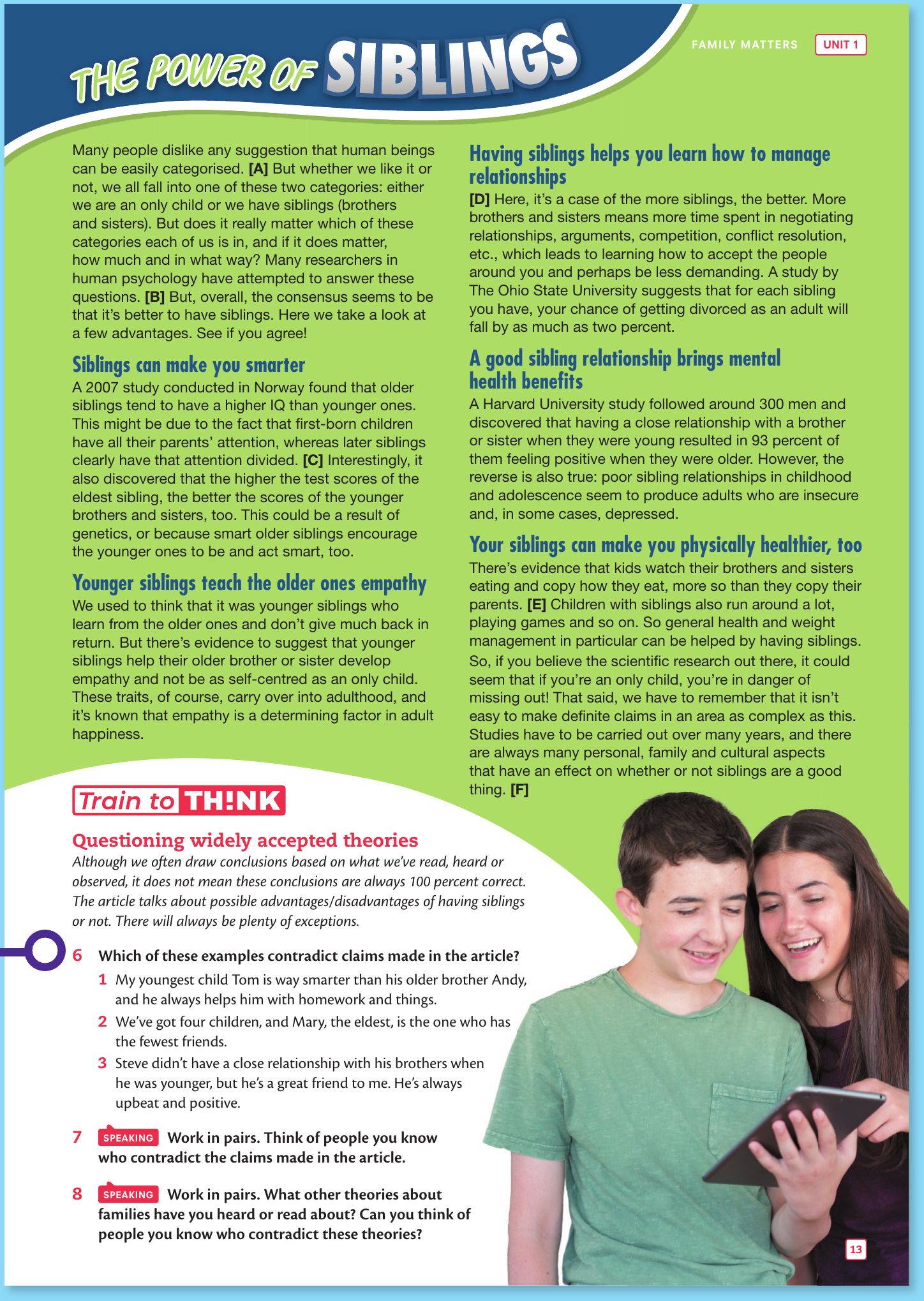
Put the sentences back句子回填 · 约 13 分钟 · Exercise 4 + 音频 1.01
Guiding questions(每个空都走这四步)
- Read the sentence before the gap and the sentence after it. What's the job of the missing sentence: reason, contrast, example, or conclusion?
- Find the reference word in each option (this, their, they, that way). What does it need to point back to?
- Does it fit both sides of the gap, not just the topic?
- Which two sentences have nothing to point back to? Why are they tempting?
| Sentence | Its "hook" |
|---|---|
| 1 Having siblings can help you become more skilled socially. | topic sentence: introduces a point |
| 2 No doubt, future research will provide some explanation for this question. | needs a question just before |
| 3 This is not to say that an only child will necessarily be unhealthy. | needs a health claim about only children |
| 4 In this sense, they have a role model… rather than an adult one. | needs "copying a sibling, not a parent" |
| 5 After all, people are complex and see themselves in that way. | gives a reason for a dislike |
| 6 It's one area where arguably the only child has an advantage… | needs an only-child advantage |
| 7 But that's only part of the story. | one explanation before, another after |
| 8 Their findings do not provide us with a very clear-cut answer. | needs a plural group of people |
After all = reason · But = turn · In this sense = interpretation · No doubt = confident prediction
A 5 · B 8 · C 7 · D 1 · E 4 · F 2(not used: 3, 6)
A → 5 People "dislike… being categorised"; After all gives the reason: people are complex and see themselves that way.
B → 8 "Many researchers… have attempted to answer these questions." → Their findings… After the gap: "But, overall, the consensus…" fits a non-clear-cut answer.
C → 7 Before: first-borns get all the attention. After: "Interestingly, it also discovered…" = the rest of the story.
D → 1 Opens the section on managing relationships; then "Here, it's a case of the more siblings, the better."
E → 4 Kids copy siblings' eating "more so than they copy their parents" → a role model their own age rather than an adult one.
F → 2 "…whether or not siblings are a good thing" = this question.
方法:看空前一句和后一句,再找选项里的"钩子词"(this、their、after all、but)指回什么。两个陷阱:3 以 This 开头,但前文从没说独生子女不健康,This 钩不到东西;6 说独生子女有优势,但 C 段讲的是老大,不是独生子女。只看话题词就会选错。
课堂对话
Exercise 4. Six gaps, eight sentences, two fakes. The fakes are designed to share a topic with a paragraph. So if you match by topic, you'll fall for them. We're going to match by hooks.
Let's do A together. Before the gap: "Many people dislike any suggestion that human beings can be easily categorised." After the gap: "But whether we like it or not, we all fall into one of these two categories." What job does the missing sentence do?
It explains why people dislike being categorised. So it's a reason.
Which sentence is built to give a reason?
Number 5, "After all, people are complex and see themselves in that way." "After all" introduces a reason.
And "that way" points to…?
Being complex. Not easy to put in a box.
Both sides fit: they dislike boxes, after all they're complex, but whether we like it or not, we're in a box. Now gap B. Before: "Many researchers in human psychology have attempted to answer these questions." Find a plural pronoun.
Number 8: "Their findings do not provide us with a very clear-cut answer." "Their" means the researchers.
And check the other side. After the gap: "But, overall, the consensus seems to be that it's better to have siblings." Does "But" make sense after "no clear-cut answer"?
Yes. No clear answer, but most of them agree on one thing.
Now the trap. Gap E, in the health section. Before it, kids copy how their brothers and sisters eat, more so than they copy their parents.
I chose 3, because this paragraph is about health and sentence 3 says "unhealthy".
And that's exactly the trap they built for you. Same topic, so it feels right. But test the hook. "This is not to say that an only child will be unhealthy." What's "this"? Did the sentence before say only children are unhealthy?
No, it's about copying brothers and sisters, not about only children at all.
So "this" has nothing to grab. Which sentence picks up "more than their parents"?
Number 4. "They have a role model who is more or less their own age, rather than an adult one." "Rather than an adult" matches "more so than they copy their parents".
There it is. Match the hook, not the topic word. 别一看到 healthy 就上头. You've got C, D and F in pairs. Circle the hook, check both sides, and decide which two are fakes. Four minutes.
巡视。卡住的组只问一句:"What does this word point back to, and does the next sentence still make sense?"
Before I say anything, listen to the full article and check.
播放音频 1.01。
Answers: A5, B8, C7, D1, E4, F2. Fakes: 3 and 6. Justify C.
Before C, first-borns have all their parents' attention. After it, "Interestingly, it also discovered…" so there's more to the study. "But that's only part of the story" links them.
And D?
D starts a new section, so it needs a topic sentence. Number 1 introduces social skills, and then "Here, it's a case of the more siblings, the better."
So the more siblings you have, the more better you are at relationships.
You've got the idea perfectly. The structure is "the more…, the better", and "better" is already a comparative, so no "more" in front of it. Say the article's version and then your own.
The more siblings, the better. And for me: the more I argue with my brother, the better I get at winning arguments.
Ha! And why is 6 a fake?
It talks about an only-child advantage, but gap C is about first-borns, not only children.
Exactly: tempting, wrong group. And F?
"This question" is "whether or not siblings are a good thing", and number 2 says future research will explain it.
So look at the shape of the whole article: five confident headings, and three sentences, 5, 8 and 2, all quietly saying "it's complicated". That's hedging, and it's going to matter in Exercise 5.
Test the research on your own family拿自己家检验 · 约 9 分钟 · Exercise 5 + Mixed-ability
Guiding questions
- Do you have siblings? If not, who in your family does? Pick one finding from the article to test on that person.
- Does the finding fit? If it does, is that proof, or could something else explain it?
- If it doesn't fit, does that mean the research is wrong?
- How important is it, really, whether you're an only child or have siblings, compared with parents, school or culture?
- Back to the big question: real difference, label, or it depends? Has your position moved?
The article claims that ___. In my family, that seems to hold / doesn't really hold, because ___.
That said, it could just as easily be down to ___.
Compared with ___, I'd say it matters a great deal / to some extent / surprisingly little.
第 3 轮输出:讲家人时用一句 tend to 和一句 be always -ing。表亲 cousin 不是 sibling。
That said, … = 话虽如此(文中原话)
Q1: My mum's the eldest of three, and the article claims older siblings tend to have a higher IQ. In her family that seems to hold: she's the one who went to university. That said, it could just as easily be down to the fact that her parents had more money when she was young.
Q2: Compared with parents and school, I'd say it matters to some extent, but surprisingly little. A strict school or a very anxious parent tends to shape you far more than the number of kids at the dinner table.
开放题。示范的关键是 That said:一个例子符合研究,不等于证明了研究;一个例外也推翻不了研究。表亲是 cousin,不是 brother / sister。有理有据就算对。
课堂对话
The researchers have had their say. Now you're the data. Exercise 5. Hands up if you're an only child. OK, quite a few. Then you'll test the research on a parent, an aunt, an uncle. Everyone has someone.
Take one minute alone first. Choose one finding from the article and one real person. Make notes, don't write sentences yet.
Mixed-ability:同水平同学两两一组;基础弱的给 1 分钟思考时间再开口。
Now talk. Use the frame: "The article claims that… In my family, that seems to hold, or doesn't really hold, because…".
The article claims that younger siblings teach older ones empathy. In my family that seems to hold. My brother is six years younger, and since he was born I've had to be much more patient.
Lovely. Now the C1 question: is that proof, or could something else explain it?
It could just as easily be down to growing up. Maybe I'd be more patient now anyway, at seventeen.
"It could just as easily be down to…" That's the move of a careful thinker. Someone with a finding that doesn't fit?
I'm an only child, but I have a brother, he's my uncle's son. We grew up together.
I know exactly what you mean: in Chinese he's your 哥哥. But in English, your uncle's son is your cousin. You can say "he's like a brother to me".
I'm an only child, but my cousin's like a brother to me. We tend to fight like real brothers, and he's always borrowing my stuff without asking.
Both structures in one go, 漂亮. So does the article's claim fit your situation?
Not really. The article says only children miss out on learning to manage relationships, but I learned all of that with my cousin.
So: the research is wrong?
Yes, the research is wrong, because my experience contradicts with it.
That's a brave conclusion. Two things. "Contradict" takes a direct object, no "with": my experience contradicts it. And is one cousin enough to make a study of hundreds of people wrong?
No. My experience contradicts it, but that doesn't make the research wrong. It just means there are exceptions, like the article says.
That's what the writer meant by "that said". Second question. How important is it, really, whether you're an only child or have siblings? Compare it with something else.
Compared with parents, I'd say it matters surprisingly little. Parents decide how much attention you get, whether you have siblings or not.
I disagree a bit. I'd say it matters a great deal, because you spend thousands of hours with a sibling. You can't ignore that.
Both positions, both with a mechanism. Last thing: look at your position from the warmer. Real difference, label, or it depends? Who's moved?
I've moved from "real difference" to "it depends". There seem to be some real patterns, but the article itself admits it isn't clear-cut.
Exit ticket出门票 · 约 5 分钟 · 写下来才算学会
Your task
- Answer the big question in 3–4 sentences: is "only child vs. siblings" a real difference, a label, or does it depend?
- Support your view with one finding from the article and one real person.
- Swap with a partner and check them against the checklist. What's missing?
Checklist:
☐ tend to + base verb ☐ be always + -ing ☐ one hedge (seems to · arguably · that said · it could be down to)
☐ one word from today (consensus · empathy · traits · insecure · clear-cut · categorised)
I'd say there are some real patterns, but the answer is far from clear-cut. The article claims that younger siblings teach older ones empathy, and that seems to hold for my mum, who tends to notice when anyone in the room is upset. That said, my uncle, the youngest, is always interrupting people, so being in a big family clearly didn't teach him much! I think we like to categorise people, but parents and personality traits probably matter more than birth order.
范文结构:立场 → 文章证据 + 真人 → That said 让步 → 结论。tend to、is always -ing、一个 hedge、一个新词都在里面。
课堂对话
Last five minutes, and nobody leaves without a ticket.
Answer the big question in writing: real difference, label, or it depends. Three or four sentences. One finding from the article, one real person.
The checklist is on the board: "tend to", "always -ing", a hedge, and one word from today. Which hedges did we collect?
Seems to, arguably, that said, and it could be down to.
Good. Start with your position, then your evidence, then your "that said". Three minutes.
学生写 3 分钟,然后和同桌交换,按 checklist 打勾。
Swap. Check four things. Is there a base verb after "tend to"? Is there an "is" or "are" before "always"? Is there a hedge? Is there a word from today?
She wrote "my brother always borrowing my charger". I think it's OK.
Read it again with your teacher's eyes. Something small is missing in the middle.
Oh, "is". My brother is always borrowing my charger.
Exactly. Who wants to read theirs out?
I'd say there are some real patterns, but the answer is far from clear-cut. The article claims that younger siblings teach older ones empathy, and that seems to hold for my mum. That said, my uncle, the youngest, is always interrupting people!
Position, evidence, hedge, and a joke at your uncle's expense. Perfect.
Today: you gave photos a voice, you put six sentences back by following hooks, and you learned that even a confident article ends with "it's complicated". Next lesson we ask: if a study says one thing and your family says another, who do you believe?
重点句型练四遍换形式重复输出,不是抄四遍
2 say it 说自己→3 add a line 续写→7 test on family 聊家人→8 write 写下来